





Things to know about sweet wine
March 23, 2011
Sweet wines, like disingenuous youth, are often misunderstood, maligned, patronized, and dismissed as a passing phase. Blame it on bad PR, misguided marketing, or historic winemaking indiscretions, but sweet wines have been given short shrift and often relegated to the tail-end of the dinner to accompany that <em>molten chocolate cake</em>. Fair enough. There’s absolutely nothing wrong with a glass of slightly chilled glass of heady <em>Banyuls</em> from the southern Mediterranean area of France. But they are something more than so-called, <em>dessert wines</em>, they’re not all just grape candy in a glass, many being caught somewhere in the middle between a <em>dry</em> wine and <em>dessert</em>. No, these wines that have endured since the beginning of winemaking, are contemplative in complexity, good ones torturous to produce, and lush in their diminutiveness. Dessert wines with a pear tartin? Maybe, but sweet wines can be a <em>just</em> dessert unto themselves or something completely different. Sweetness in a wine is often frowned upon by wine drinkers, a trait perhaps indicating a lack of sophistication or an element of inferiority. Get with the program people
<h2>Sweetness as a Defining Characteristic</h2>
Wines can be dry, medium dry, medium, and ultimately, sweet with the level of residual sugar (RS) determining the classification. Residual sugars are the remaining amounts of sugar in the wine after final fermentation. RS is most often measured as grams/liter (g/l) with the very sweet wines weighing in at 45 g/L and above, some way above. Dry wines will be about 2.5 g/L or less. The <em>sweetness</em> taste factor is mitigated by other wine components such as acidity, tannins, alcohol, and temperature. Often a sweet wine is balanced by the wine’s acidity. An example is the floral and honeysuckle <em>Vouvray</em> from France’s Loire Valley. Made from Chenin Blanc, white Vouvray wines can have healthy doses of sweetness but the wine’s acidity tempers the sweetness and gives it a dry character and makes it a perfectly legitimate mate to a meal rather than dessert. Conversely, infuse a high alcohol percentage into the wine will make a dry wine seemingly sweet, sweet as a Zinfandel <em>Fruit Bomb</em>.
<h2>Types of Sweet Wines</h2>
The best sweet wines are made in one of two ways. One way is to dehydrate the grapes and reduce their water content and concentrate the sugars. A second way is to boost the alcohol as is done to make <em>fortified wines</em> such as <a title=”Port” href=”http://wine.lovetoknow.com/wiki/Port”>Port</a> and Sherry. The following is background on the these types of wines:
<ul>
<li>Botrytis – In the common vernacular this is <em>Noble Rot,</em> a fungus that is a disaster for wine growers trying to make a dry table wine. However, it produces a sigh of relief for those trying to make sweet wines. Essentially, the <em>botrytis cineria</em> is a spore-like fungus that attack healthy grape clusters in the late autumn and grows, feeding on the grape’s sugars. Damp nights and warming days helps to dry the grapes and prevents total decomposition. The resulting epitome can be found in those marvelous Sauternes from Bordeaux (Think <a title=”http://www.yquem.fr/” href=”http://www.yquem.fr/” target=”_blank”>Chateau d’Yquem</a>), the Tokaji from Hungary, and the <em>Auslese</em> or <em>Beerenauslese</em> from Germany’s Rheingau.</li>
<li>Eiswein – German for <em>Ice Wine</em> these wines are made from frozen grapes. These grapes are picked during a hard frost and frozen. When the frozen orbs are pressed the sugar concentrated juices are separated from the grape’s icy water. Because grapes for Eiswein’s are picked very late in the season while waiting for winter’s chill, the grapes are very ripe and produces captivating sweet white wines with extracted fruit and high acidity that make them excellent with food. Eisweins are also produced in Canada and Austria.</li>
<li>Late Harvests – Simply, grapes are left on the vines in the <em>late</em> autumn to ripen to their fullest. The grape clusters can be left to dry on the vines, picked and dried indoors or just laid down on the vineyard ground to shrivel in the sun and do their best impression of a raisin. Late Harvest wines are not usually as complex as Noble Rot or Eisweins but they are full of sticky honey, deep fruit flavors, and floral bouquets.</li>
<li>Fortified Wines – Neutral grape spirits such as brandy are added to the wines during fermentation which arrests the process, kills the sugar consuming yeast, and holds the RS level while giving the wine an alcohol boost upwards to 18-20%. A small glass of a fortified wine goes a long way. Examples of this process are Port from Portugal and Banyuls, Muscat de St. Jean de Minervois, and Maury from France’s Languedoc-Roussillon region.</li>
<h2>Types of Grapes</h2>
Sweet wines are made with grapes from all over the varietal board, red or white. Here are a handful of the most common with some associated sweet wines:
<ul>
<li>Sémillon (Primary grape for Bordeaux Sauternes)</li>
<li>Viognier</li>
<li>Chardonnay</li>
<li>Chenin Blanc (Vouvray and Savennières-Loire Valley)</li>
<li>Riesling (Alsace and Rheingau)</li>
<li>Gewürtztraminer (Alsace and Rheingau)</li>
<li>Muscat/Moscato (Moscato d’Asti, Muscat d’Alsace, Muscat de Beaumes-de-Venise, Muscat Cannelli)</li>
<li>Trebbiano (Vin Santo-Tuscany)</li>
<li>Furmint (Primary grape for Hungary’s Tokaji Aszú)</li>
<li>Grenache (Banyuls, Maury)</li>
<li>Zinfandel (Late Harvest Zinfandel/California)</li>
</ul>
<h2>Sweet Wines and Food</h2>
The first thing to remember is there are no hard and fast rules when pairing food with wines. In fact, people can get overly vexed and start throwing a pox upon everyone’s house trying to figure out what works perfectly with a certain wine or a particular food. Relax, lighten up. That said, there are a couple of guidelines that can help. Salty foods contrast nicely with acidic wines but then they also contrast nicely with sweetness. When trying to match a sweet or dessert wine with dessert, it’s best to match a sweet wine with a dessert that downplays the sugar, say a honeyed Muscat Canelli together with an apple tart. Wine and food are also similar to the class structure in society. Therefore it always helps to pair up richness with richness. As you know, rich foods don’t like to intermingle with wines from across the tracks and vice versa.
<h2>Intriguing Treats</h2>
Okay, here are a few sweet wine and food hook-ups that never fail.
<ul>
<li>Foie Gras with Sauterne</li>
</ul>
This is a classic bit of decadence with the fatty-rich foie melting in your mouth and cranked up by complex honey-acid grandeur of the Sauterne. If this combination doesn’t convert you then skip the foie and stick with the Sauterne by itself or nibble on some dry and crumbly blue-veined cheese. If the Sauterne is too pricey, as an alternative try a Jurançon (Not the Sec version) from the Pau region in the French Pyrenees.
<ul>
<li>Stilton and Port</li>
</ul>
This combination works for some people but others forego the Stilton and just drink the Port. Works for me.
<ul>
<li>Chocolate and Wine</li>
</ul>
This is a tough category but people keep trying to find the perfect match. Granted its difficult but sometimes it works. Personally, I stick to bittersweet chocolate (Valrhona) and the darker the better and share it with a Late Harvest <a title=”Riesling” href=”http://wine.lovetoknow.com/wiki/Riesling”>Riesling</a>, Late Harvest <a title=”Zinfandel” href=”http://wine.lovetoknow.com/wiki/Zinfandel”>Zinfandel</a>, Banyuls, or Port. Many people like to try it with <a title=”Cabernet Sauvignon” href=”http://wine.lovetoknow.com/wiki/Cabernet_Sauvignon”>Cabernet Sauvignon</a> as well. Best to keep the wine sweeter than the chocolate and the stronger the chocolate then the wine should follow suit.
<ul>
<li>Marcona Almonds and Sherry</li>
</ul>
I love to munch on roasted Marcona almonds from Spain and sip a nutty Oloroso or Cream Sherry.
There are countless options, many yet discovered. When in doubt what goes with that glass of Maury, try sipping the wine first and see if something comes to mind. If nothing materializes take pleasure where you find it.
Source: http://wine.lovetoknow.com/wiki/Sweet_Wine
Wine lover’s choice – Yats Restaurant and Wine Bar – for the most impressive and practical wine list in the Philippines, over 2700 selections, enough to satisfy the most fastidious connoisseurs. Wine lovers and gourmand foodies from Hong Kong, Singapore, Japan, Korea and Malaysia dine at Yats Restaurant & Wine Bar when they visit Philippines and bring home some rare vintage wines too.
An excellent wine list is not just about 1st growth and cult Cabernet but a seemingly unending selection of affordable aged vintage wines that are not available anywhere else, not even in the best wine shops around town. Yats Restaurant has just that.
Visitors to Clark Philippines and Angeles City no longer suffer from lack of choices for places to eat out or wine and dine. Clark Philippines reviewed over 50 establishments and came up with three top choices in guide to best restaurant in Clark Freeport
Clark Philippines lists Top Three Restaurants in the Clark Freeport Zone and Angeles City areas of Philippines Pampanga province. Clark Freeport is a bustling new cosmopolitan city complete with its own Clark International Airport.
Topping the list is the famous fine-dining Yats Restaurant and Wine Bar located inside Mimosa Leisure Estate of Philippines Clark Freeport.
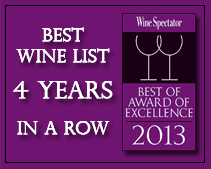
This restaurant in Pampanga Philippines is highly recommended by food critics and frequent diners in Manila as a place to wine and dine in Angeles City Clark Freeport Zone. Although it is a famous fine dining restaurant with an award winning 3000-line restaurant wine list, Yats Restaurant is also a popular restaurant for family with children. Aside from French Mediterranean haute cuisine, this restaurant also serves healthy food and the best vegetarian cuisines in the Philippines.
For comments, inquiries and reservations click on <a href=” http://www.yatsrestaurant.com/booking/index.html”>Click here for inquiry and reservations</a>
Restaurant@Yats-International.com
(045) 599-5600
0922-870-5178
0917-520-4401
Ask for Pedro and Rechel
<a href=”http://www.YatsRestaurant.com”>www. YatsRestaurant.com</a>
Getting to this fine dining restaurant of Angeles City Clark Freeport Zone Pampanga Philippines
How to get to this fine-dining restaurant in Clark Philippines? Once you get to Clark Freeport, go straight until you hit Mimosa. After you enter Mimosa, stay on the left on Mimosa Drive, go past the Holiday Inn and Yats Restaurant (green top, independent 1-storey structure) is on your left. Just past the Yats Restaurant is the London Pub.
http://www.youtube.com/watch?v=5u5vLLIlNgw
Yats Restaurant & Wine Bar
Mimosa Drive past Holiday Inn, Mimosa Leisure Estate,
Clark Freeport Zone, Pampanga, Philippines 2023
Manila Sales Office
3003C East Tower, Phil Stock Exchange Center,
Exchange Rd Ortigas Metro Manila, Philippines 1605
(632) 637-5019 0917-520-4393 Rea or Chay
For any assistance in planning and organizing a wedding ceremony, indoor or outdoor garden reception or to find other wedding service providers, Click here to contact us <a href=”http://www.philippinesweddingvenue.com/?page_id=4″>click here</a>
For assistance in hotel and resort bookings in Clark, Pampanga, Philippines, log on to
<a href=”http://www.HotelClarkPhilippines.com”>http://www.HotelClarkPhilippines.com</a>
To buy wine in Manila, Pampanga, Angeles City, Clark or Subic please log on to <a href=”http://www.ClarkWineCenter.com”>http://www. ClarkWineCenter.com</a>
To inquire with the highly recommended beach resort hotel in Clark Pampanga visit <a href=”http://www.ClearwaterPhililippines.com”>http://www.ClearwaterPhililippines.com</a>
For more information about Clark, Pampanga, Philippines log on to
<a href=”http://www.ClarkPhilippines.com”>http://www.ClarkPhilippines.com</a>